
Why lift alarms, emergency phones, and building safety systems require attention before January 2027
Openreach’s UK-wide stop sell for legacy copper products commenced in September 2023, with the industry’s target for PSTN withdrawal set at 31 January 2027. New orders for legacy analogue services are now restricted (provider and area dependent), and the technology is in managed withdrawal. Organisations that continue to rely on PSTN lines for emergency voice systems – lift alarms, help points, or roadside phones – require an upgrade plan: See the PSTN deadlines.
A significant number of emergency voice endpoints across the UK remain connected to analogue lines. Migrations are already underway by area and provider, meaning some locations may lose service before the final deadline.
For voice-first applications, migration does not necessarily require full system replacement. VoiceLink provides a retrofit path that converts analogue voice lines to 4G VoLTE, maintaining emergency communication capability without the complexity and cost of replacing endpoint equipment.
This guide is therefore intended for:
- Facilities and estates teams managing multiple sites with lift alarms or emergency voice systems
- Lift and access contractors supporting legacy autodiallers
- Transport and public realm operators responsible for help points or SOS phones
Regulatory Context
The consequences of inadequate migration planning are significant. In December 2025, Ofcom fined Virgin Media £23.8 million following failures that put vulnerable customers at risk during the transition to digital services: Ofcom enforcement notice.
While that case involved telecare – a different application with distinct technical requirements – the underlying principle applies broadly: regulators are scrutinising safety-critical communications during this transition. Organisations responsible for emergency voice infrastructure should anticipate equivalent accountability standards.
For facilities managers, property owners, and transport operators, the relevant question is not whether to act, but how to act in a manner that maintains reliability while minimising disruption and cost.
Scale of the Remaining Migration
There is no single national inventory of PSTN-connected emergency voice endpoints, but available evidence indicates a substantial residual base of analogue services and connected devices, for example:
- Ofcom data cited by the UK Parliament indicates that, as of December 2024, around 5.2 million residential landline customers were still on the PSTN [House of Commons Library], which likely indicates ongoing use in other buildings as well.
- In rail alone, the Office of Rail and Road reports more than 4,500 customer help points across over 2,100 stations [ORR], which will need auditing to validate whether they are post-PSTN shutdown compatible.
In practice, estates teams often discover analogue lines in unexpected places – especially in older buildings and at remote or unmanned sites. An audit is typically, therefore, the first and most important step.
Infrastructure Reliability
PSTN degradation is not a future concern – the network is actively deteriorating. The underlying challenges are well documented: ageing equipment beyond its operational lifespan and declining availability of qualified maintenance personnel: the engineers with legacy infrastructure expertise are retiring or moving towards other technologies, and replacement parts are often no longer manufactured. Ofcom in its Connected Nations report (2024) also noted that the UK’s legacy fixed network is becoming increasingly difficult to maintain, stating that “qualified personnel to maintain and repair ageing equipment is declining, and equipment is beyond its intended lifespan”. While reported PSTN incidents decreased in Ofcom’s latest data (Connected Nations, 2025), one possible explanation is the shrinking customer base rather than improved reliability – as customers migrate to digital services, incidents will affect fewer people and fall below reporting thresholds.
Delaying migration until late 2026 compresses the remediation window, particularly for challenging sites such as lift shafts and basements where coverage or compatibility issues may require additional work.
The Triple Sunset: Why 4G Matters
The PSTN switch-off is occurring alongside the retirement of legacy mobile infrastructure. UK mobile networks are simultaneously withdrawing their 2G and 3G services. A key point as some older emergency call systems use 2G/3G mobile as a back up for the primary PSTN connection.
- The 3G switch-off is well advanced, establishing 4G/VoLTE as the practical baseline for new safety-critical voice deployments: For more information, see the Ofcom 3G switch-off guidance.
- 2G networks also now have confirmed end dates. All major UK operators have now confirmed to the government that they do not intend to offer 2G services beyond 2033 (and in the case of EE the 2G sunset is confirmed as May 2029, with Vodafone’s 2G sunset confirmed as occurring in 2030. For more information, see Ofcom’s 2G/3G current expectations. System designs therefore should prioritise 4G to avoid a subsequent migration cycle after 2G services have closed.
This convergence creates a triple sunset: Organisations that migrate from PSTN to older cellular technology may face another forced migration within several years and less reliable services.
The most sustainable approach for most estates is direct migration to 4G, where VoLTE is carried natively on 4G networks and engineered for real-time voice, making it a more sustainable choice than legacy 2G/3G circuit switched fallbacks.
Affected Applications
Organisations relying on any of the following applications likely have PSTN-connected equipment requiring migration:
Lift Emergency Alarms
BS EN 81-28:2022 requires every passenger lift to provide two-way voice communication with a monitoring centre. The standard specifies test calls at regular intervals – typically every 72 hours. Indeed, recent interpretations of the standard have placed increased emphasis on these test calls, and ensuring they reflect the actual alarm route. For example, shortcuts such as SMS-only testing may not satisfy the intent of the standard as tests should replicate the actual alarm pathway. The standard also specifies battery backup requirements for both the autodialler and any GSM gateway. The implication is that a PSTN-to-VoLTE retrofit therefore requires auditable test calls and power resilience from the outset.
The practical implication is that connectivity should be treated as part of the lift safety system. Commissioned end-to-end with the monitoring centre and maintained with test-calls and verified and audited documentation.
Housing providers, healthcare estates, commercial property managers, and facilities management teams, that operate lifts on premises must therefore take note of these requirements as failure will establish a clear compliance event.
Motorway and Highway Emergency Phones
Emergency phones along motorways and major A-roads connect directly to control centres and serve as a critical resource for stranded motorists, particularly in areas with limited or unreliable mobile coverage.
Smart motorway Emergency Refuge Areas introduce additional requirements, with phones at closer intervals requiring reliable connectivity in challenging roadside environments.
Help Points and Emergency Voice Lines
Emergency help points across transport hubs, car parks, retail sites, and commercial premises provide voice communication for assistance and security. These voice-first applications are suitable candidates for 4G VoLTE conversion, particularly at remote or unmanned locations where broadband connectivity may be unavailable.
Petrol forecourts, railway stations, multi-storey car parks, and shopping centres commonly feature PSTN-connected help points that may also require migration.
Building Safety and Refuge Systems
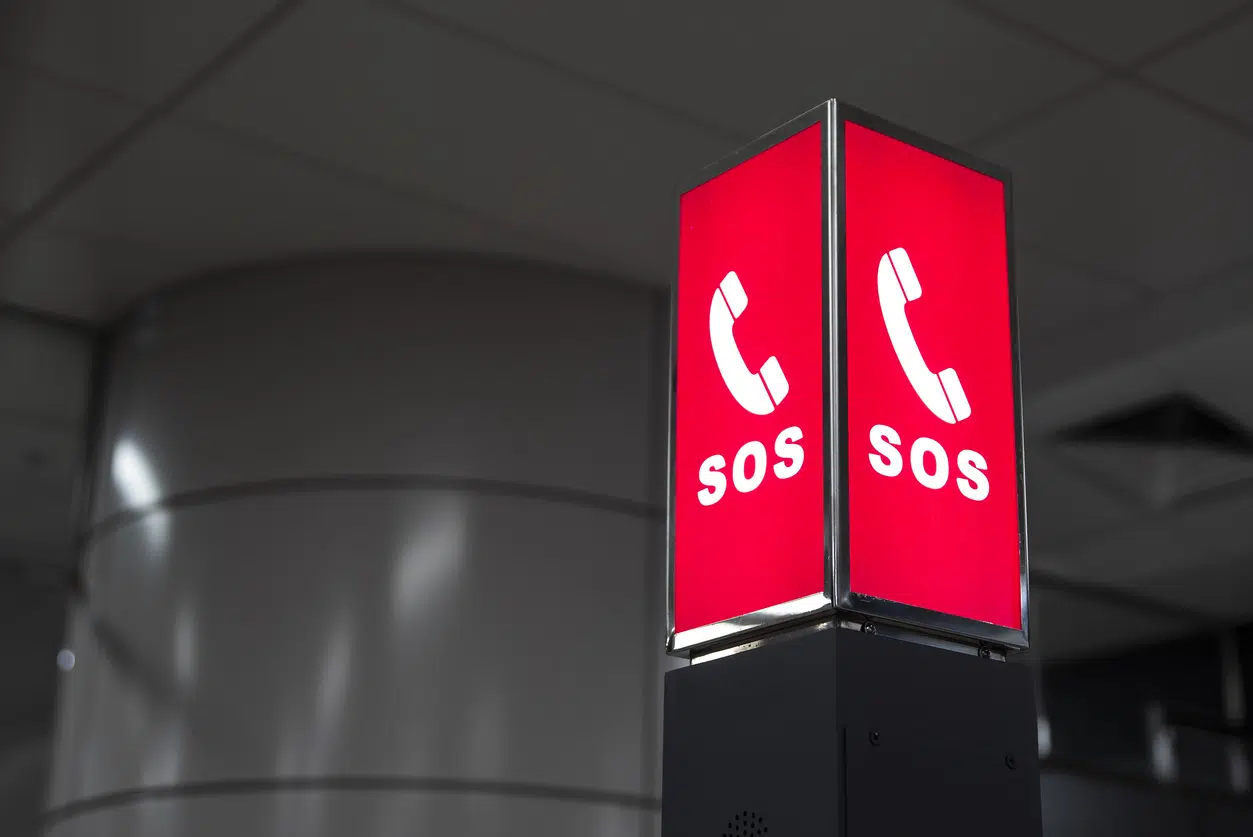
Building regulations guidance and relevant standards commonly require disabled refuge points with voice communication in multi-storey non-domestic buildings. Under BS 5839-9 and BS 9999, Emergency Voice Communication (EVC) systems must provide reliable two-way speech for evacuation assistance.
Within the current regulatory environment, building safety investment is rightly increasing. Ensuring EVC systems remain operational through the PSTN migration is therefore an current compliance consideration for building owners and managers.
The Voice-First Distinction
Not all PSTN applications present equivalent migration challenges. The critical distinction lies between these two categories:
- Voice-first = human-to-human speech → suitable for VoLTE
- Data-over-voice = tones/handshakes before speech → requires end-to-end validation
For example:
Voice-first applications follow a straightforward pattern: a button press initiates a call, and human-to-human speech follows. The autodialler establishes the connection; everything subsequent is voice communication. Lift alarms, emergency help points, and SOS phones typically operate this way.
Data-over-voice applications operate differently. For example, some devices transmit coded DTMF or modem tones to receiving equipment before voice communication opens. These tones convey device ID, location, and alarm type through precise audio frequencies. If codec compression distorts these tones, the receiving system may not in all cases function correctly. As an example, industry guidance – including from bodies such as the TSA – also notes that analogue devices often send data as audible ‘voiceband’ tones in some cases, which can be corrupted or lost over digital networks. This distinction underscores the importance of end-to-end testing for any application relying on this form of tone-based signalling.
Native digital data that is sent digitally over 4G and 5G networks is unaffected as it is not subject to this audio tone codec compression.
The VoiceLink Solution for PSTN to VoLTE Migrations
CSL VoiceLink is a 4G VoLTE PSTN converter designed for voice-based emergency applications. It enables organisations to retain existing and expensive autodiallers and endpoint equipment while changing only the bearer – from analogue PSTN to cellular 4G. For voice-first endpoints, VoiceLink therefore reliably preserves call setup and two-way speech for devices such as lift alarms or voice call emergency systems.
Key capabilities:
- 4G VoLTE: Addresses the triple sunset by defaulting to the network technology with the longest operational runway.
- Utilises SIMs with multi-network coverage: Multi-network VoLTE capability greatly improves connectivity probability in lift shafts, basements, and other locations where single-network coverage may be marginal
- Built-in battery backup (8 hours standby / 2 hours talk time): Maintains operation during mains failures.
- HD voice quality: VoLTE wideband audio supports clear emergency communication
- Retrofit installations: Connects to existing analogue equipment with minimal disruption where equipment changeout is complex.
Achieving reliable connectivity: Appropriate antenna placement and pre-installation signal surveys are essential, particularly in challenging RF environments. Each installation should be commissioned with a live test call to the monitoring centre or control room. Ongoing test-call processes and documentation provides the evidence trail for compliance verification.
Deployment Requirements
Successful deployment requires attention to the following factors:
- Coverage verification: Confirm cellular signal strength at each location. Multi-network roaming SIMs provide resilience where single-network coverage is marginal. Lift shafts and basement areas require particular attention: see CSL’s Signal Analyser for assistance in completing this pre-survey.
- Antenna placement: External antenna mounting may be necessary in RF-challenging environments to achieve reliable connectivity.
- Power backup alignment: Confirm the battery backup specifications meet service continuity requirements and relevant standards.
- Commissioning test calls: Test each installation with live calls to the receiving monitoring centre to confirm end-to-end operation.
- Ongoing test schedule: Implement periodic test calls as required by relevant standards (e.g., 72-hour intervals for lift alarms under BS EN 81-28).
- Acceptance criteria: Define clear pass/fail criteria: successful connection to monitoring centre, clear and understandable two-way speech, and completion of required test-call schedules.
Timeline Considerations
As discussed, PSTN migrations are already well underway. Organisations managing estates with multiple emergency voice endpoints should therefore plan now for:
- Site Audits: Identify all PSTN-connected emergency voice endpoints across the estate
- Planning of Migrations: Perform coverage assessments, check equipment specifications, and initiate procurement requirements
- Test Deployments: Installation, commissioning, and testing at each location to ensure compliance
- Contingency: Allowance for remediation at those sites that have coverage or compatibility challenges
Early action provides the best opportunity for orderly transition and avoids resource constraints as the January 2027 completion date approaches.
Frequently Asked Questions
Does VoLTE work with lift alarm autodiallers?
In most voice-first lift alarm deployments, VoLTE performs effectively. VoiceLink presents an analogue line interface to the autodialler and converts the call to 4G VoLTE. The determining factors are monitoring centre compatibility and successful call-path testing. Validation of call setup and two-way audio with the monitoring centre should be completed during commissioning.
What if 4G signal is unavailable in the lift shaft?
VoiceLink utilises a multi-network SIM capable of connecting to all locally available mobile networks, which greatly improves coverage in marginal signal areas. For particularly challenging locations, external antenna mounting can extend coverage into lift shafts and basements. A pre-installation coverage survey will identify the appropriate approach for each site: see: CSL signal Analyser.
Why not use a 2G GSM gateway?
2G and 3G networks are being retired across Europe. While UK operators have indicated 2G will remain available for some time yet, there is no indefinite guarantee. Installing a solution that relies primarily on legacy networks creates exposure to another migration requirement sooner than necessary. VoiceLink’s 4G VoLTE-first design enables organisations to avoid a near-term second migration by deploying technology with the longest operational runway.
How is compliance demonstrated?
Commission each installation with a live test call to the monitoring centre, confirming two-way voice communication. Implement the ongoing test schedule required by the relevant standards – for lift alarms under BS EN 81-28, this typically means test calls every 72 hours using the same communication pathway as actual alarms. Document each test for compliance records.
What occurs during a power failure?
VoiceLink includes built-in battery backup providing 8 hours standby and 2 hours talk time, maintaining emergency communication capability during mains failure. For applications requiring extended backup duration, additional UPS solutions can be specified. Requirements should be confirmed with the lift contractor or compliance advisor.
Next Steps
For organisations with emergency voice infrastructure still connected to PSTN, CSL can assist with:
- Exposure assessment: Identify systems requiring migration and prioritise by risk
- Connectivity evaluation: Help assess coverage and identify appropriate solutions for each location
- Migration planning: Develop realistic timelines aligned with operational constraints
- Compliance assurance: Help ensure systems continue to meet relevant safety standards
To initiate a coverage assessment: Provide a list of sites and postcodes. CSL will assess coverage and assist with risk-based prioritisation.
For initial guidance: Submit a single postcode and endpoint type for a preliminary compliance pathway assessment.
Please contact CSL to discuss how VoiceLink can support reliable, compliant, and future-ready emergency voice infrastructure.
About CSL
CSL is a UK-based telecommunications company specialising in resilient connectivity solutions for critical applications. With expertise spanning telecare, healthcare, fire and security, transport, and emergency services, CSL provides the connectivity infrastructure that maintains safety-critical system operation.