
BT Group will retire the PSTN on 31 January 2027. Openreach is withdrawing the products that run over it, ISDN among them. In its 31 July 2026 update, Openreach put the number of lines still running on the old copper-based phone network at around 1.5 million, including around 350,000 business premises [1]. Openreach stated in the same update that there would be no extension to the deadline. Those services need to move to digital alternatives. Where the replacement is delivered over a single broadband connection, the site depends on one circuit.
A single circuit now carries more than the line it replaces
A fixed line can be disrupted by physical damage, exchange faults or civil works, and restoration times are outside the site’s control. Without a second path, the site remains dependent on that single connection.
Previously, services such as alarm signalling, lift communications and card payments were often connected through separate, dedicated lines. After migration, these services may share one broadband connection alongside CCTV, access control and applications used by staff. If that connection fails, every service using it can be disrupted at the same time.
How broadband with 4G failover works
CSL Broadband and the CSL Router are designed and delivered as one service.
CSL Broadband provides the primary path: a private, fully managed connection on a closed network rather than the open internet, with a static IP, UK-based support and a defined service level agreement.
The CSL Router provides the second path. The fixed line carries day-to-day traffic while the router monitors it. If the line becomes unavailable, the router automatically switches traffic to 4G. When the fixed line is restored, the router switches traffic back automatically, avoiding the need for someone to identify the recovery and restore the primary path manually.
The same arrangement can provide 4G failover for broadband that CSL did not supply. Depending on the broadband service and site configuration, the CSL Router can connect to the third-party fixed line directly or be installed alongside the customer’s existing router. It uses the fixed connection as the primary path and switches traffic to 4G when that path becomes unavailable.
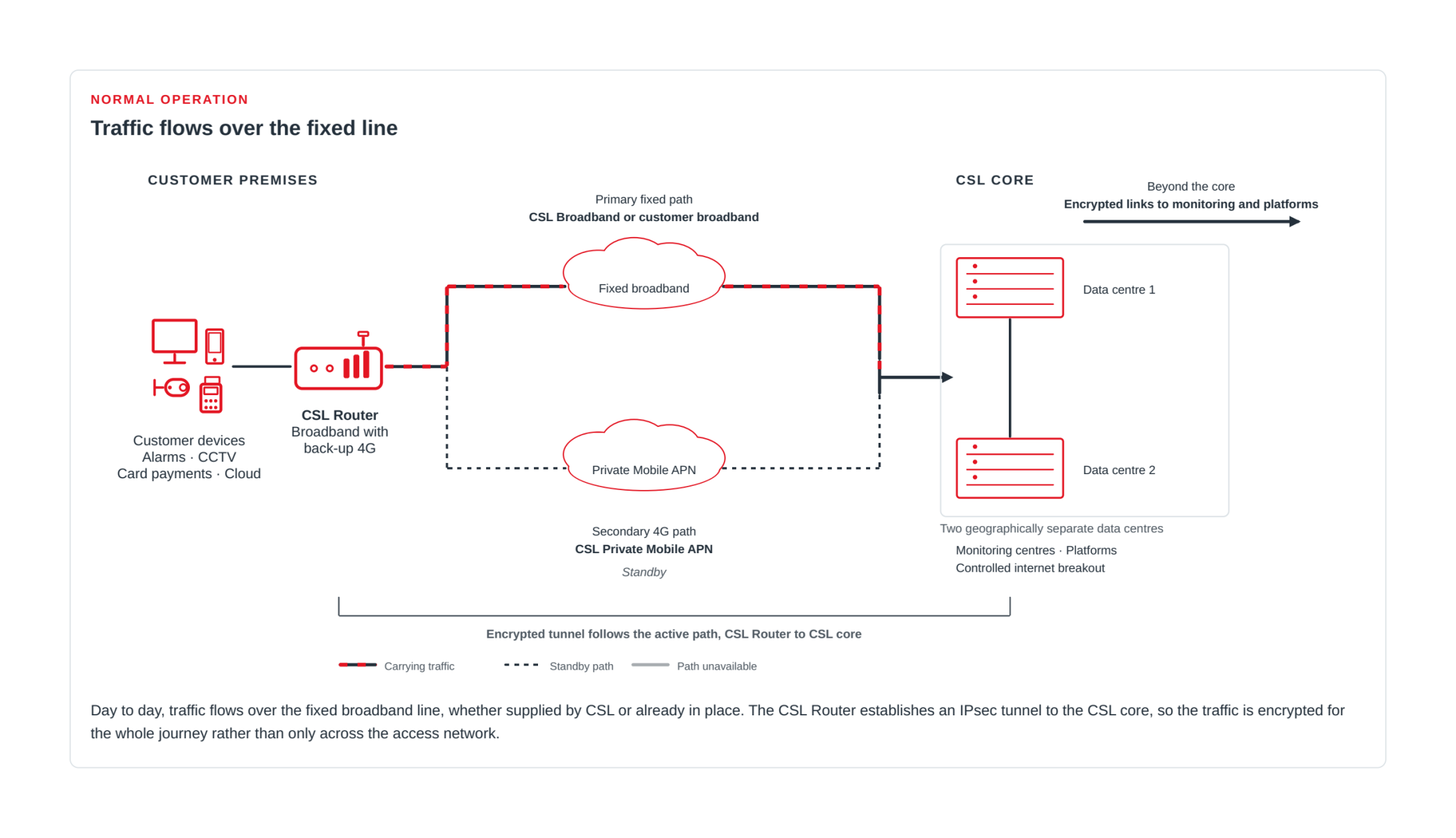
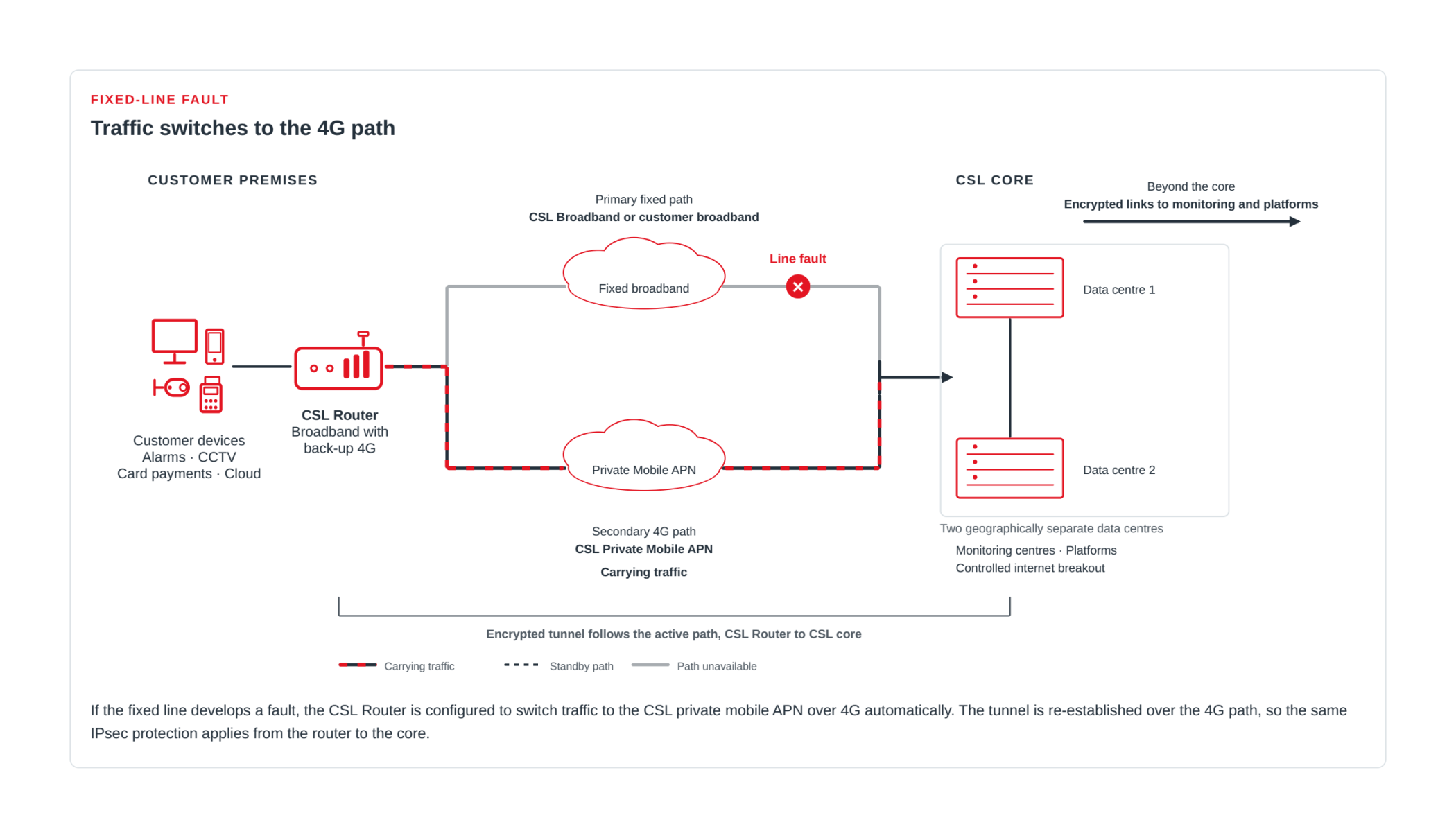
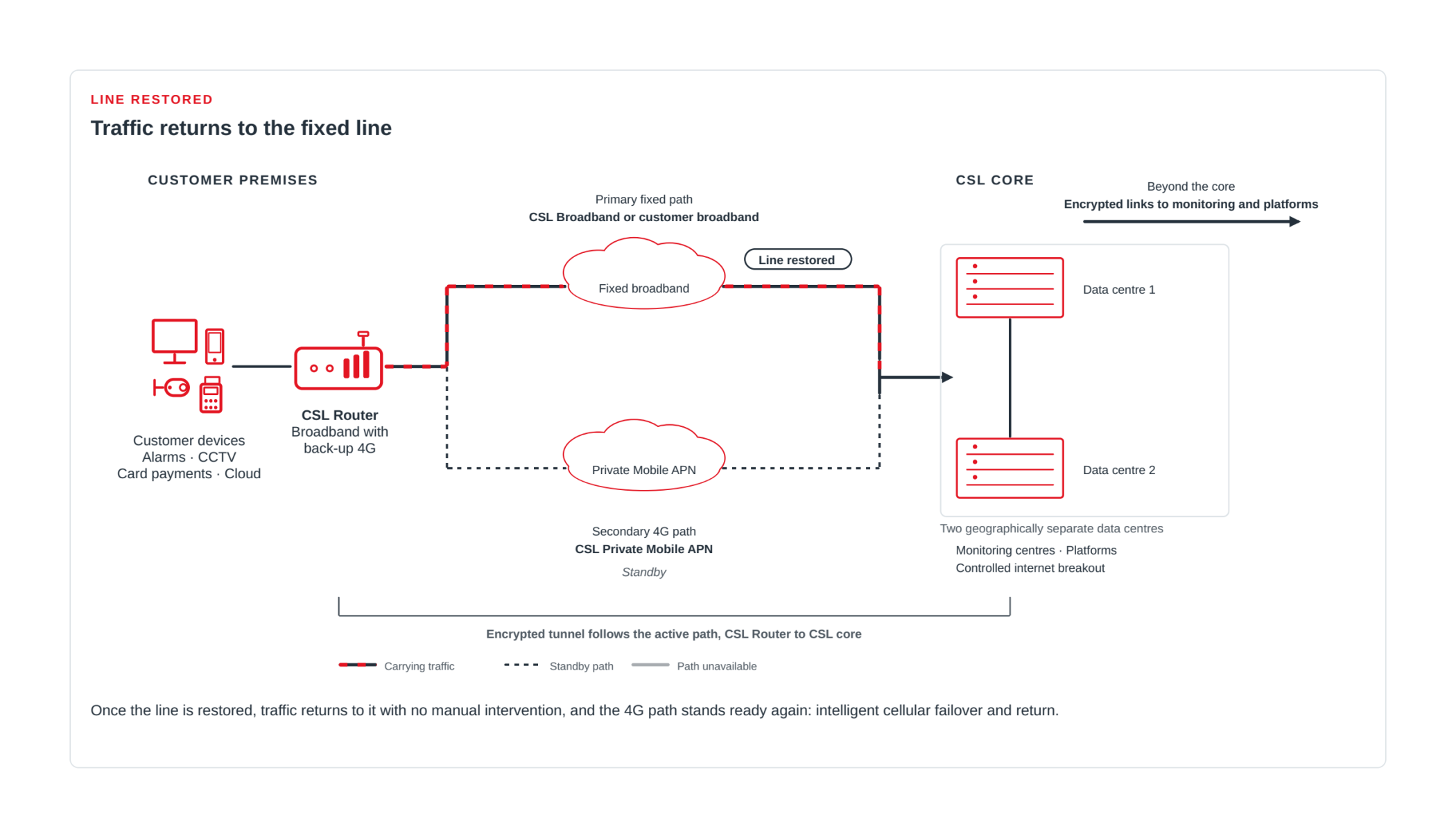
Figure 1. Fixed-to-cellular access-path diversity. The two CSL data centres provide resilience within the managed service platform. They are not the two independent operator mobile cores used in a DualCore arrangement.
Two paths are not automatically independent
Failover helps to the extent that the second path does not share the failure conditions of the first.
Reaching several radio networks through one shared mobile core does not create several independent paths. Where two profiles are aggregated into the same core, a disruption inside that core affects both at the same time.
Two SIMs in a device therefore provide independence at the mobile-core layer only where each connects through a separate operator core. A management portal showing two operator names records a commercial arrangement rather than proving architectural separation, so core independence has to be evidenced separately.
The same test applies on the fixed side. Two circuits entering a building through one duct, or terminating at one exchange, are two services with a single physical dependency.
What DualCore adds
DualCore resilience operates at the core-network layer. It uses two independent operator core networks with failover between them, so that disruption inside one core does not affect the other. CSL delivers it two ways. In a dual-SIM router where independent cores are specified, the router makes the switching decision. In the rSIM service, that decision is made on the SIM itself. Either way, the independence extends to the mobile core, not only to the radio network.
CSL applies path diversity in three ways. Broadband with cellular failover provides two access paths using different technologies: a fixed connection and a mobile connection. A suitably configured dual-SIM router or rSIM can also provide resilience between independent mobile operator cores. Across a multi-site estate, the hub model allows these arrangements to be deployed and managed consistently.
In the router. Where broadband is available, the fixed connection provides the primary path and cellular provides the second. This creates diversity across two access technologies, but it is not a DualCore arrangement. The CSL Router can also be supplied in dual-SIM configurations where a usable fixed line is unavailable. Where the selected SIMs route through independent operator cores, that configuration delivers DualCore resilience, subject to the SIMs selected, local coverage and service configuration.
In the SIM. The rSIM service, CSL’s patented resilient SIM, uses a DualCore design to hold two independent multi-network operator profiles on one SIM. It monitors its own connection and switches to the backup profile when the active profile becomes unavailable, without a manual swap and without an instruction from the network.
Across the estate. The multi-site hub model brings every location into one private network with central visibility. It standardises configuration rather than adding a resilience mechanism, and it is what makes the first two arrangements deployable across an estate.
Two connectivity paths do not make the entire service resilient. Both paths may still depend on the same site power supply, connected equipment and destination application. A complete resilience review therefore needs to consider these shared dependencies as well as the connectivity.
The second path needs the security of the first
The second path must protect traffic to the same standard as the primary path. Switching traffic to an unmanaged public internet connection during a fixed-line failure could expose it to risks that the primary service was designed to avoid.
The two paths reach the CSL core by different means. On a CSL Broadband site the primary path runs on CSL’s segregated managed network. The second path enters CSL’s Private APN. Both paths use IPsec-encrypted backhaul into the core, so the same security policy applies whichever one is in use. Private destinations remain on controlled interconnects. Traffic that requires internet access reaches it through managed breakout at the core, with the routing and breakout following the configuration agreed for the deployment.
Units are supplied preconfigured and hardened, without default credentials. Where remote access is required, authorised users can connect securely to equipment behind the router without exposing that equipment directly to the public internet. Connections are monitored as part of the managed service, with alerting and response determined by the service configuration.
One service, one line of accountability
When the broadband connection, router and 4G failover are supplied separately, identifying which component has failed may require the customer to contact several providers. Taking them as one managed service gives the customer one support contact responsible for investigating the complete connection and coordinating its restoration.
The timing is tighter than the date suggests
A UK-wide stop sell on traditional WLR lines has applied since 5 September 2023 [3]. A further stop sell applies under the FTTP Priority Exchange programme once full fibre reaches more than 75 per cent of premises in an exchange area [2]. The tranche published in July 2026 added 112 exchanges covering 554,918 premises [2].
Openreach has also introduced tiered wholesale price rises for legacy WLR products. It raised basic WLR rental in April and July 2026 and will raise it again on 1 October 2026. Together, the three increases will double the rental compared with its level before the April increase [4]. The effect on the customer’s retail price will depend on the communications provider. Openreach has begun sending formal notifications to communications providers with outstanding migrations [1].
Migrating earlier keeps the schedule under the customer’s control. It also leaves time to specify what each site actually needs, rather than accepting whatever a like-for-like swap leaves behind.
Next steps
The switch-off date is fixed, but the number of paths and the independence between them are specified site by site at migration. Revisiting that decision after the copper has been removed requires a further site visit and further configuration.
To review which of your lines are affected, and what each site needs in order to stay connected through a fault, contact the CSL team at sales@csl-group.com.
Sources
[1] Openreach, Openreach warns businesses: just six months left before the UK’s old phone network is switched off, 31 July 2026. https://www.openreach.com/news/openreach-warns-businesses-just-six-months-left-before-the-uks-old-phone-network-is-switched-off/
[2] Openreach, Openreach puts a stop to copper for another half million premises in bid to push customers to new digital lines, 27 July 2026. https://www.openreach.com/news/openreach-puts-a-stop-to-copper-for-another-half-million-premises-in-bid-to-push-customers-to-new-digital-lines/
[3] Openreach, Stop Sell: WLR withdrawal. https://www.openreach.co.uk/stopsell
[4] Openreach, Openreach announces price changes to encourage digital adoption of newer, more reliable and better value technology, 12 November 2025. https://www.openreach.com/news/openreach-announces-price-changes-to-encourage-digital-adoption-of-newer-more-reliable-and-better-value-technology/
Further reading
BT Business, The PSTN and ISDN switch-off: what it means for you. https://business.bt.com/help/article/phone-line-and-services/move-from-traditional-lines-to-the-cloud/the-pstn-and-isdn-switch-off-what-it-means-for-you/
Openreach, Time for a big switch-up as PSTN switch-off looms, February 2026. https://www.openreach.com/news/time-for-a-big-switch-up-as-pstn-switch-off-looms/
Dates and figures reflect publicly stated industry information at the time of writing.