The Hidden Vulnerability
The UK’s public EV charging network has grown to over 88,000 devices, yet reliability remains the top barrier to EV adoption. Industry KPIs report 95–99% “uptime”, but independent analysis shows driver session success rates are 10–20 percentage points lower than reported device uptime.
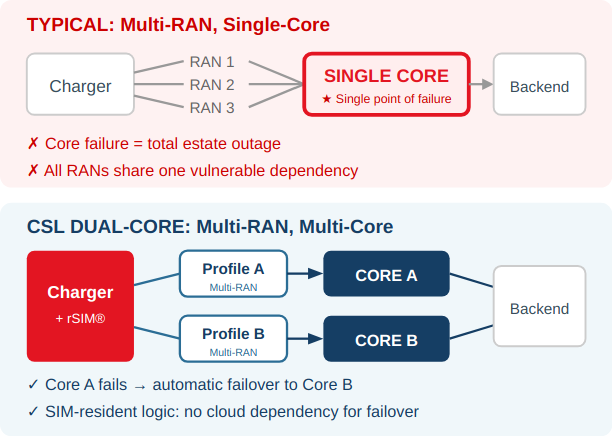
The gap is connectivity. Most operators rely on multi-RAN, single-core cellular architectures: multiple radio networks, but all traffic routed through a single MVNO core. When that core fails, every device goes down simultaneously.
| 88,513 | UK public charge point devices (Zapmap, Jan 2026) |
| 10–20% | Gap between reported uptime and actual driver session success rate |
| 2–4 / yr | Typical correlated outage events per estate per year |
The false sense of security
A “multi-network” SIM gives the impression of redundancy. In reality, if all profiles route through the same MVNO core, a single infrastructure failure takes down the entire estate. UK MNO core outages affect millions of connections and can last hours to days.
Independent vs correlated outages
An independent outage affects a single device (local signal loss, hardware fault). A correlated outage takes down entire estates when a shared dependency fails: the MVNO core, an authentication platform, or a certificate authority. A single correlated event can generate more revenue exposure in one afternoon than a year of independent faults.
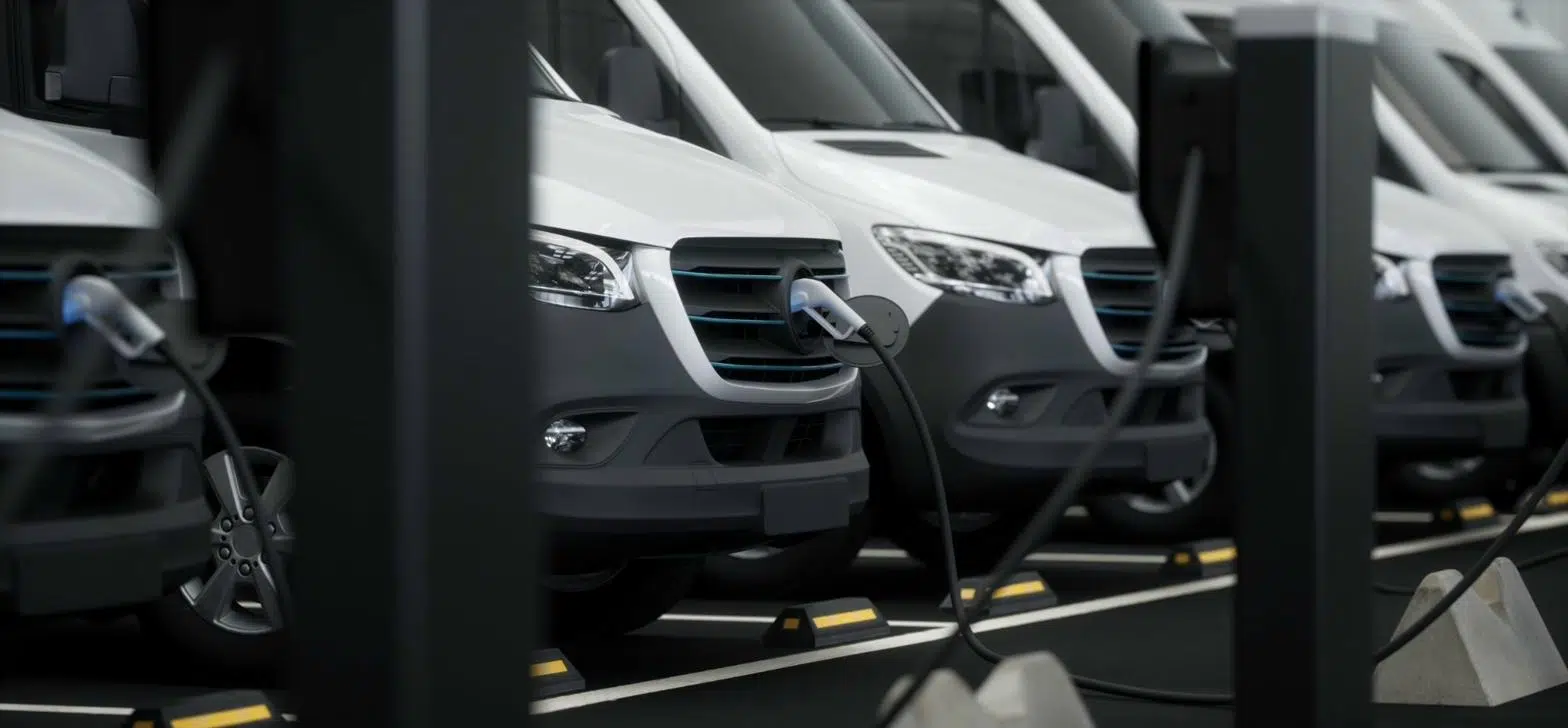
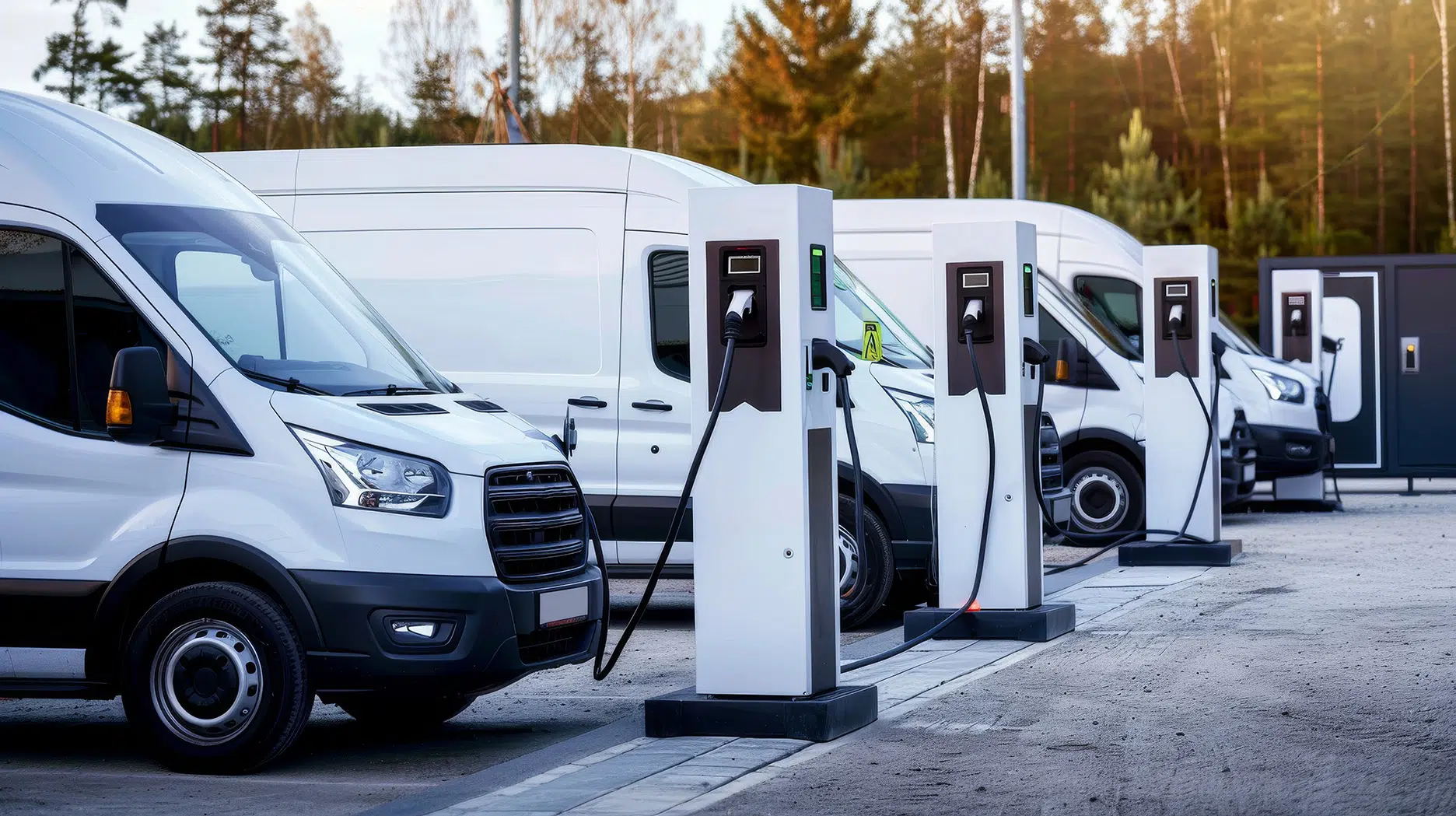
| Fleet depot risk: When overnight charging fails, vehicles don’t deploy. A single outage grounding 12 vans can cost £6,300 per incident in direct costs, with annual exposure reaching £12,600–£18,900 for recurring faults. |

Why Don't Multi-Network SIMs Fix It?
The answer lies in network architecture, not radio coverage. In a typical deployment, multiple radio access networks converge on a single MVNO core — the shared dependency that multi-RAN diversity cannot protect. CSL’s Dual-Core architecture maintains two fully independent core network paths, so a failure in one triggers autonomous failover to the other.
With CSL DualCore, a core outage triggers an automatic profile switch. Chargers resume operation autonomously, without manual intervention, service visits, or truck rolls.
What Does Connectivity Downtime Actually Cost?
Revenue at risk = Power (kW) × Utilisation × Tariff (£/kWh) × Downtime hours. Using GFI utilisation benchmarks, RAC Charge Watch and Zapmap Price Index tariff data, and CSL field monitoring:
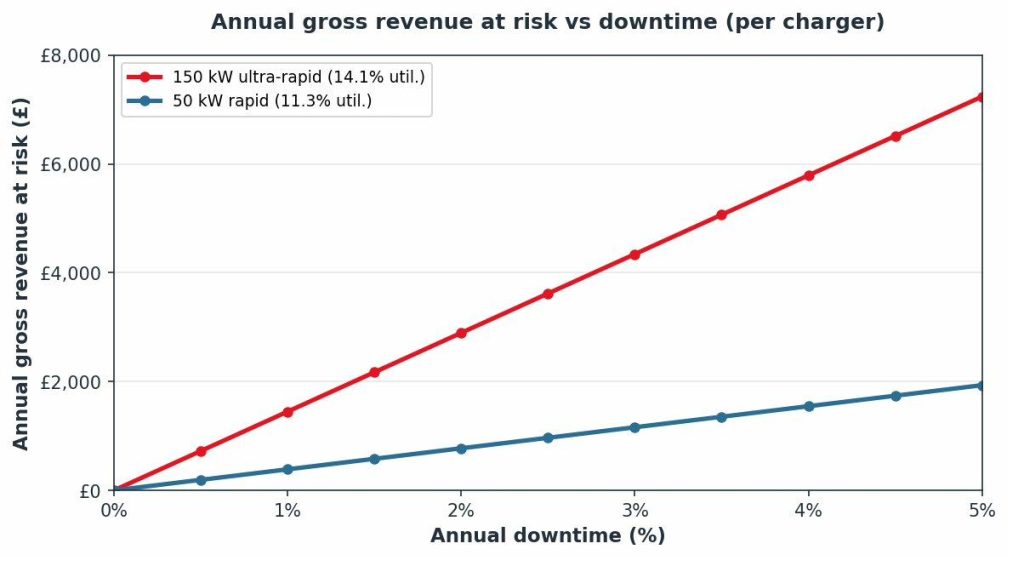
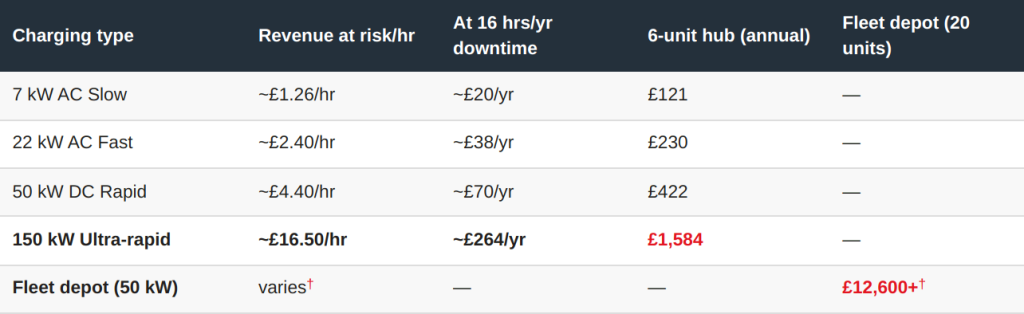
Fleet depot costs reflect vehicle grounding and SLA penalties, not energy revenue alone. A single correlated outage grounding 12 vans costs~£6,300 per incident; annual exposure of £12,600–£18,900 assumes 2–3 recurring events.
Worked Example: 6-Charger Motorway Hub
High usage and high revenue sites are also highly at risk:
| Site: 6 × 150 kW ultra-rapid. Utilisation: 14.1%. Tariff: £0.78/kWh PAYG.
Revenue at risk (16 hrs/yr): 6 × £264 = £1,584/yr Avoided truck rolls (CSL data): 3–4 × £220 = £660–£880/yr Potential exposure reduced: £2,244–£2,464/yr (illustrative) |
Beyond revenue: Correlated outages create SLA breaches, regulatory exposure, contract risk, and reputational damage. Estate-wide carrier failures can create £100k+ exposure.

The Solution: CSL DualCore & PACE Architecture
True resilience requires core independence, not just radio diversity. CSL’s architecture addresses the root cause: shared infrastructure dependencies.
DualCore rSIM®
Two fully independent operator profiles, each with its own core network, embedded on a single UICC. Failover logic resides on the SIM itself: not on an external platform that may be unreachable during the outage it needs to resolve.
- Eliminates single-core SPOF: Autonomous failover when one core fails
- True diversity: Independent authentication, routing, and infrastructure
- SIM-resident logic: No cloud dependency for failover decisions
- OTA reprovisioning: Remote profile updates without truck rolls
PACE Architecture (for high-value hubs)
For sites where even radio-layer disruption is unacceptable, PACE adds successive fallback layers:
- Primary: Broadband (bonded multi-link) – always on
- Alternate: Cellular (independent radio path)
- Contingency: Alternative cellular path
- Emergency: Satellite backup – when all terrestrial links fail
Get the Executive Summary of the White Paper
Ready to Assess Your Connectivity Resilience?
| Book a Resilience Audit
We review your current connectivity architecture and identify single points of failure. |
Explore Your ROI
Share your estate profile (charger count, mix, and utilisation) and we’ll work with you to model the risk and build a resilience business case tailored to your network. |