


Introduction
A connected device can report a strong signal, stay attached to the network, and still pass no data. The radio is working, but the fault sits further upstream, in the operator core or signalling path. From the device’s side, nothing appears wrong, so failover that switches on signal alone may never trigger. From your platform’s perspective, the data simply stops arriving.
This often happens because connected devices may still depend on a single core network. Even a multi-network or roaming SIM that can access several radio networks typically routes traffic back through one core, leaving each radio path exposed to the same upstream dependency.
For an OEM, the consequences can extend beyond the connectivity incident itself. Support costs rise, engineers investigate hardware that is functioning correctly, warranty claims can be wrongly attributed to the device, recurring revenue can be put at risk, and customer confidence can suffer.
Wider coverage alone does not solve this. More radio access does not necessarily protect against a failure in the core. For many connected products, resilience depends on having a second, independent path the device can move to when the first one fails.
Resilience built into the SIM
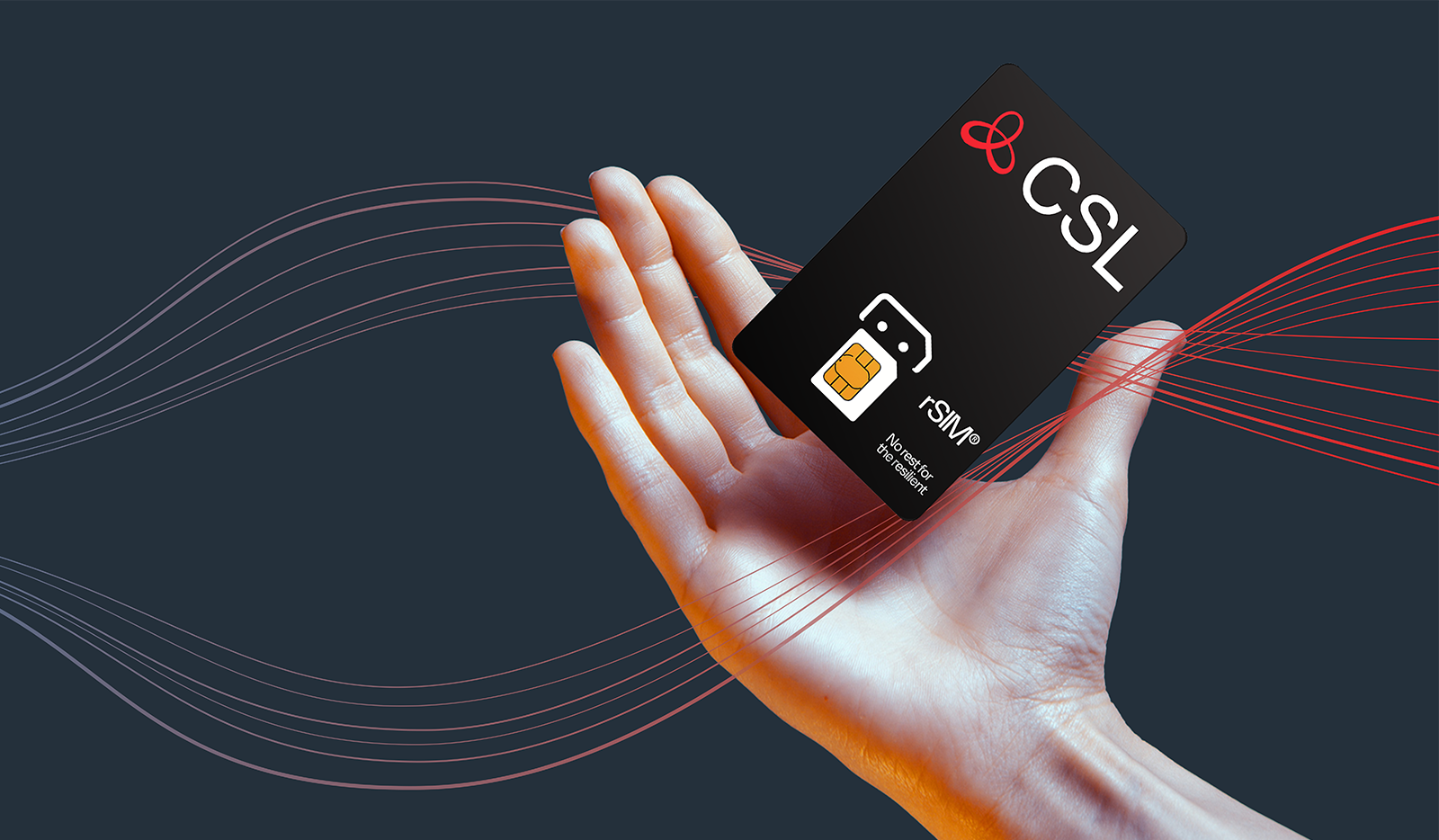
CSL rSIM® provides that resilience at the SIM layer. It holds two independent core network profiles on a single SIM: a Primary and a Fallback, and takes the switching decision on the SIM itself rather than in the device firmware or the network. To the device, it behaves like a standard SIM. Behind that standard interface, it operates differently.
Because that decision sits on the SIM, rSIM does not need to depend on the disrupted network path to trigger failover. It also checks real data activity and throughput, not just signal strength, so it detects loss of service even when the radio reports a healthy signal. When the Primary path recovers, the device can return to it automatically through the configured failback process.
As rSIM delivers DualCore® resilience through a single SIM, devices that accept standard UICC or eUICC SIMs can avoid a dual-SIM hardware redesign. Ongoing profile management can then be handled centrally.
As with any cellular design, failover still depends on suitable fallback coverage, routing and destination availability, so CSL confirms appropriate comms plans and routing for each deployment as part of setup.
rSIM therefore provides a different and potentially more cost-effective route to resilience than the usual alternatives:
- A roaming SIM can improve radio access, but it may not remove dependencies in the active network path.
- A dual-SIM hardware design can add redundancy, but it adds module, firmware, certification and stocking complexity.
- rSIM is designed to sit between those options: SIM-layer resilience using one SIM, configured for the device and the deployment model.
What changes for your product (and what does not)
For engineering and operations, little has to change. The majority of integrations happen through device configuration rather than firmware changes, and telemetry continues through your existing protocols and endpoints, so the device cloud does not normally need reworking.
Security can be kept consistent by applying the same private APN, routing and firewall controls to both paths, so traffic does not move to a less trusted route when the SIM switches. On unattended estates, automatic recovery can reduce site visits and help prevent some network faults from reaching your support team.
Turning resilience into product value
DualCore network resilience can be more cost-effective than a dual-SIM hardware approach because the second path does not require an extra cellular module or SIM slot. One SIM carries both paths, helping avoid additional hardware complexity.
Beyond the hardware components, connectivity is a recurring expense once a plan is active. rSIM is designed to support the commercial model you use to package, promote or recover that cost:
- Build resilience into the product at the point of manufacture, creating a clearer point of differentiation.
- Include a defined period of connectivity within the device price.
- Charge a recurring connectivity or service fee.
- Offer DualCore resilience as a premium service tier for customers with availability requirements.
Used in this way, resilience becomes part of your commercial proposition and what you sell.
This matters because procurement teams increasingly evaluate connected products against resilience, cybersecurity and operational assurance requirements, particularly where devices support critical or operationally important services.
A manufacturer that can point to resilient connectivity in the product specification, and explain how it supports uptime, assurance and service value, will be in a stronger position when those questions arise.
A proven approach, validated on your hardware
rSIM is already used in environments where a lost connection has practical consequences, including healthcare and telecare, fire and security, EV charging, utilities and lone-worker safety. Careium, Legrand Care and Evology Charging are good examples of organisations building rSIM into connected services where continuity matters. CSL has specialised in critical connectivity since 1996 and today manages over 3.5 million connections.
Before any wider rollout, CSL can demonstrate failover on a sample of your own devices, so you see rSIM switch and recover in your environment first. rSIM’s eUICC capability also aligns with GSMA SGP.32, so you can provision and switch profiles over the air as coverage, commercial terms or available networks begin to change across the product’s life.
Learn more about rSIM
Whether you are designing a new device or strengthening one already in the field, the starting point is the same: understand how your products fail, how they route traffic, and how SIM-layer resilience could support your hardware, service, coverage and recurring-revenue model.
CSL works with OEMs to assess device configuration, routing, fallback behaviour and deployment requirements before wider rollout.
rSIM is already being deployed at scale across multiple sectors: