


Choosing the right connectivity strategy today will determine whether your IoT deployments remain reliable tomorrow. Here, we therefore explore the technologies shaping IoT’s future, and why resilient SIM solutions like CSL’s patented rSIM are essential for overcoming core network outages, roaming gaps, and long recovery times.

Legacy 2G and 3G Networks: Risks for Businesses
The phase-out of 2G and 3G networks is accelerating:
- GSMA Intelligence reports: 143 networks will shut down by 2030, with 50% gone or having been scheduled by the end of 2024.
- In Europe alone, 19 operators across 14 countries will have retired 3G by the end of 2025.
- While some 2G networks are being maintained for fallback and M2M applications, their long term availability will be subject to ongoing operator and regulator reviews.
If your IoT devices depend on these networks, you may therefore begin to face:
- Service outages as coverage disappears.
- Operational disruption and potential compliance breaches.
- Financial losses from downtime in critical systems.
The business imperative: start your migration now and build resilience into your strategy.
Current IoT Specific Connectivity Options: LTE-M, NB-IoT, and Why Cat1bis Matters
LTE-M (Cat-M1)
- Pros: Supports mobility and voice (VoLTE); suitable for fleet tracking and mobile IoT.
- Cons: Patchy global deployment; roaming challenges; availability depends on regional LTE-M rollouts.
NB-IoT
- Pros: Optimised for static, low-power use cases like smart metering.
- Cons: High latency; limited roaming; rollout uneven outside certain markets.
LTE Cat1bis: The Readily Available Alternative
Unlike LTE-M and NB-IoT, which are still expanding globally, Cat1bis is already supported on existing LTE infrastructure in most mature markets, making it a practical, near-term solution for many IoT applications:
- Balanced performance: Higher throughput than NB-IoT, less complexity than full LTE.
- Immediate coverage: Operates over standard LTE networks without waiting for IoT-specific rollouts.
- Ideal for: Asset tracking, remote monitoring, and applications requiring moderate data rates and dependable roaming.
Important note: Cat1bis coverage follows LTE footprints but depends on device capability and IoT roaming agreements. Contact CSL to explore your requirements.
Business takeaway: While LTE-M and NB-IoT offer power efficiency, their limited availability and roaming inconsistencies make Cat1bis the fastest path to dependable IoT connectivity today.
Comparison Table: Key IoT Specific Connectivity Options
| Technology | Data Rate | Power Use | Mobility | Latency | Availability | Ideal Use Case |
| LTE-M | 1–4 Mbps | Low | High (VoLTE) | ~50–100 ms | Limited in some regions | Fleet tracking, some telecare |
| NB-IoT | Up to 127 kbps | Ultra-low | Low | ~1.5–10 sec | Patchy global coverage | Smart metering, sensors |
| Cat1bis | ~10 Mbps | Moderate | Moderate | ~50–100 ms | Broad LTE coverage (device-dependent) | Asset tracking, remote monitoring |
| 5G RedCap | High | Optimised | High | <10–20 ms | Early rollout (2024+, mainstream 2025+) | Industrial IoT, healthcare |
| LoRaWAN | 0.3–50 kbps | Ultra-low | Limited | >1 sec | Private/local networks | Non-critical smart city and utility apps |
Why latency matters: For real-time services such as payment systems, telecare alarms, healthcare alerts, and voice-enabled IoT, high latency can delay emergency responses and even breach compliance obligations, making Cat1bis and LTE-M preferable to NB-IoT or LoRaWAN in critical use cases.

The Key Ongoing and Transitional Role of 4G LTE
4G LTE remains the workhorse for global IoT connectivity and will continue to play a critical role for the next decade. However, its sunset is expected around 2033–2035, making it essential to plan beyond LTE while leveraging its coverage strength in the short to medium term.
Voice and Emergency Services: Migrating to VoLTE
Legacy IoT devices that rely on circuit-switched voice over 2G or 3G will lose voice capability as these networks are retired. This impacts telecare alarms, lone worker safety devices, and emergency communication systems.
VoLTE (Voice over LTE) is the standard replacement for voice in the LTE era, offering high-definition call quality and better reliability. However:
- Devices must support VoLTE profiles and be access-listed on the network.
- Not all legacy hardware can be upgraded; some may require full replacement.
- For 5G, VoNR (Voice over New Radio) will gradually take over, but adoption will follow LTE VoLTE migration.
Business implication: Audit any voice-enabled IoT estate now and plan upgrades or replacements to ensure compliance and safety-critical functionality into the future.

Next-Gen Cellular: 5G and RedCap for Scalable IoT
5G introduces capabilities that redefine IoT performance:
- Ultra-low latency: Down to 10–20 milliseconds.
- Massive IoT support: Higher device density with network slicing for guaranteed QoS.
Why 5G RedCap Matters
5G RedCap (Reduced Capability) is tailored for IoT, offering:
- Better performance than LTE-M and Cat1bis for high-demand use cases.
- Lower cost and power use than full-scale 5G.
- Ideal for: Industrial automation, healthcare monitoring, and energy networks.
Chipset availability began in 2023, but mainstream adoption will accelerate from 2025 onward. Businesses should integrate RedCap into mid-term plans while maintaining short-term resilience with Cat1bis and LTE.
Beyond Cellular: LEO Satellites for Edge Coverage
LEO satellite networks extend coverage to remote, maritime, and rural regions where terrestrial networks fail. While costly for primary use, LEO provides a powerful fallback for global IoT continuity.
Why Resilience Matters More Than Ever
IoT connectivity failures are no longer rare events, they’re an operational reality. Two major risk factors stand out:
- Core Network Outages: When a mobile operator’s core infrastructure fails, it can disrupt millions of devices simultaneously, leaving businesses without service for hours or even days.
- Roaming and Interconnect Issues: International IoT deployments face delays and service gaps due to incomplete roaming agreements and inter-operator disputes.
The CSL Advantage: Resilient SIM (rSIM)
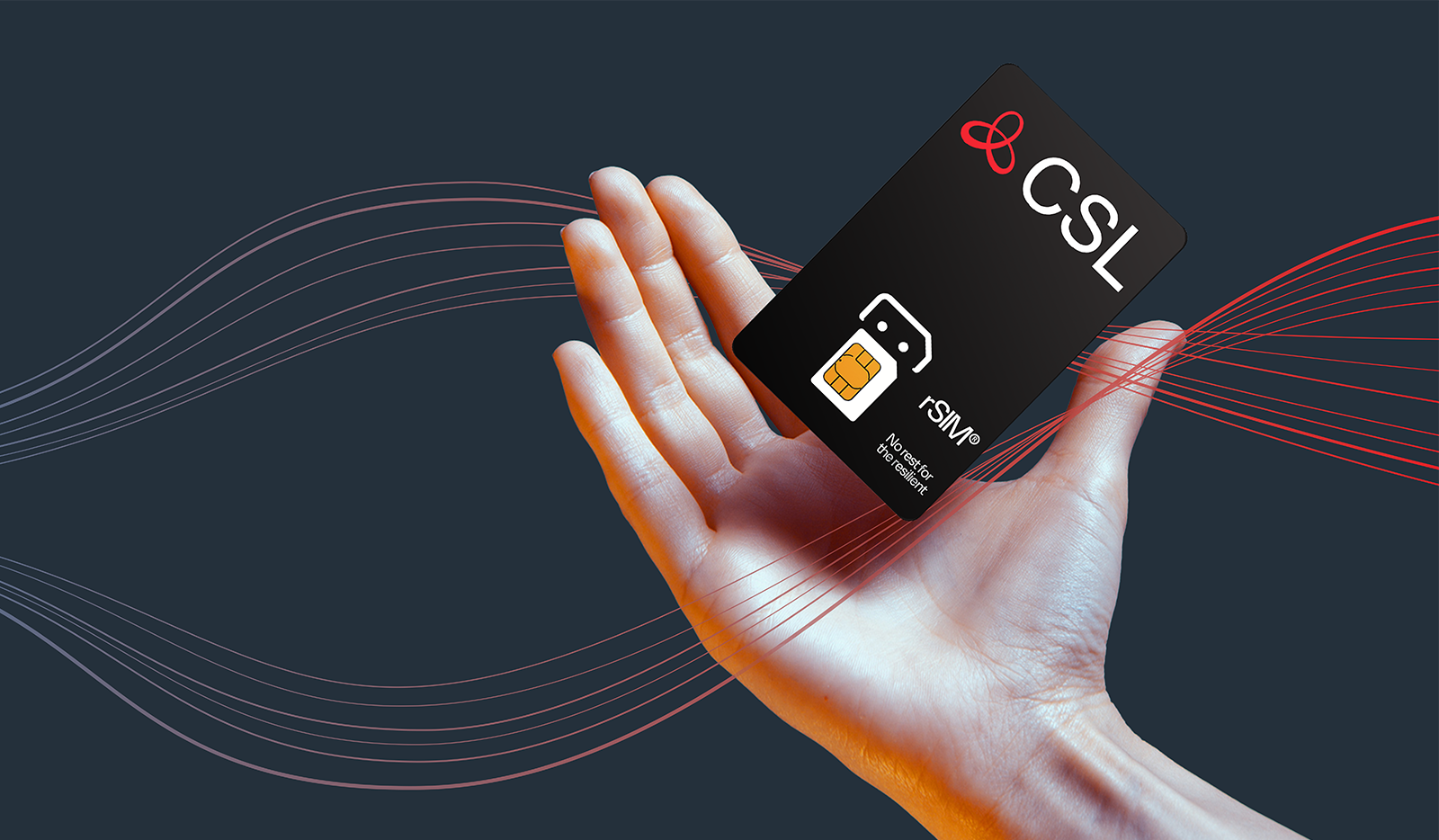
CSL’s patented dual-core rSIM was engineered to tackle these challenges head-on:
- Two independent cores from different roaming providers.
- Separate network routing, reducing reliance on a single core infrastructure.
- Automated failover to secondary connectivity when the primary network, or even its core, experiences downtime.
This architecture dramatically reduces recovery times, often from hours to seconds, ensuring mission-critical systems like telecare alarms, lone worker devices, and connected vehicles remain online.
Why this matters: Standard multi-network SIMs can still fail during widespread outages because all profiles share the same core infrastructure. rSIM solves this with true redundancy across two independent cores, delivering higher uptime and operational assurance.
What About LoRaWAN?
LoRaWAN remains popular in certain utility and smart city projects, but:
- Runs on unlicensed spectrum, which increases interference risk.
- High latency makes it unsuitable for real-time or safety-critical systems.
- Lacks global roaming and QoS features.
For enterprises prioritising scalability, resilience, and compliance, cellular-based solutions, especially when combined with rSIM, are the preferred choice.
Future Horizons: Preparing for 6G
6G promises near-zero latency, AI-driven optimisation, and terahertz-band speeds, with expected commercial availability by 2030. Future-proof IoT strategies should anticipate seamless migration from 5G to 6G without costly hardware replacements. Ensure hardware roadmaps align with 3GPP Release 18 and beyond to support these transitions.
Strategic Action Plan for Business Leaders
- Audit your IoT estate for 2G/3G dependencies now.
- Adopt Cat1bis where benefits can be gained for rapid migration while planning LTE-M or NB-IoT where relevant.
- Integrate resilient SIM technology to guard against core and roaming outages.
- Plan for 5G RedCap adoption within 3–5 years.
- Ensure compliance with GSMA, ETSI, ENISA, and UK Telecoms Security Act (already enforceable for connected services, with penalties for non-compliance).
Conclusion: Why CSL Is Your Strategic Connectivity Partner
The network sunset is inevitable. Businesses that delay risk service disruption, compliance breaches, and reputational damage.
CSL delivers resilient, future-ready IoT connectivity with:
- rSIM technology, eliminating single points of failure.
- Expertise in compliance and robust multi-network strategies.
- Solutions for critical environments where downtime isn’t an option.
Act now to safeguard and upgrade your IoT infrastructure.